
material and gesture painting
Material has always been an important part of how I work. I paint with acrylic and oil, draw with charcoal, work on paper and canvas, and increasingly return to spatial work and material research.
I do not use one material because I consider it better than another. Each has its own possibilities. Sometimes I need speed. Sometimes depth. Sometimes I want as little as possible between my hand and the surface. And sometimes I need to step away from the flat surface altogether and start building.

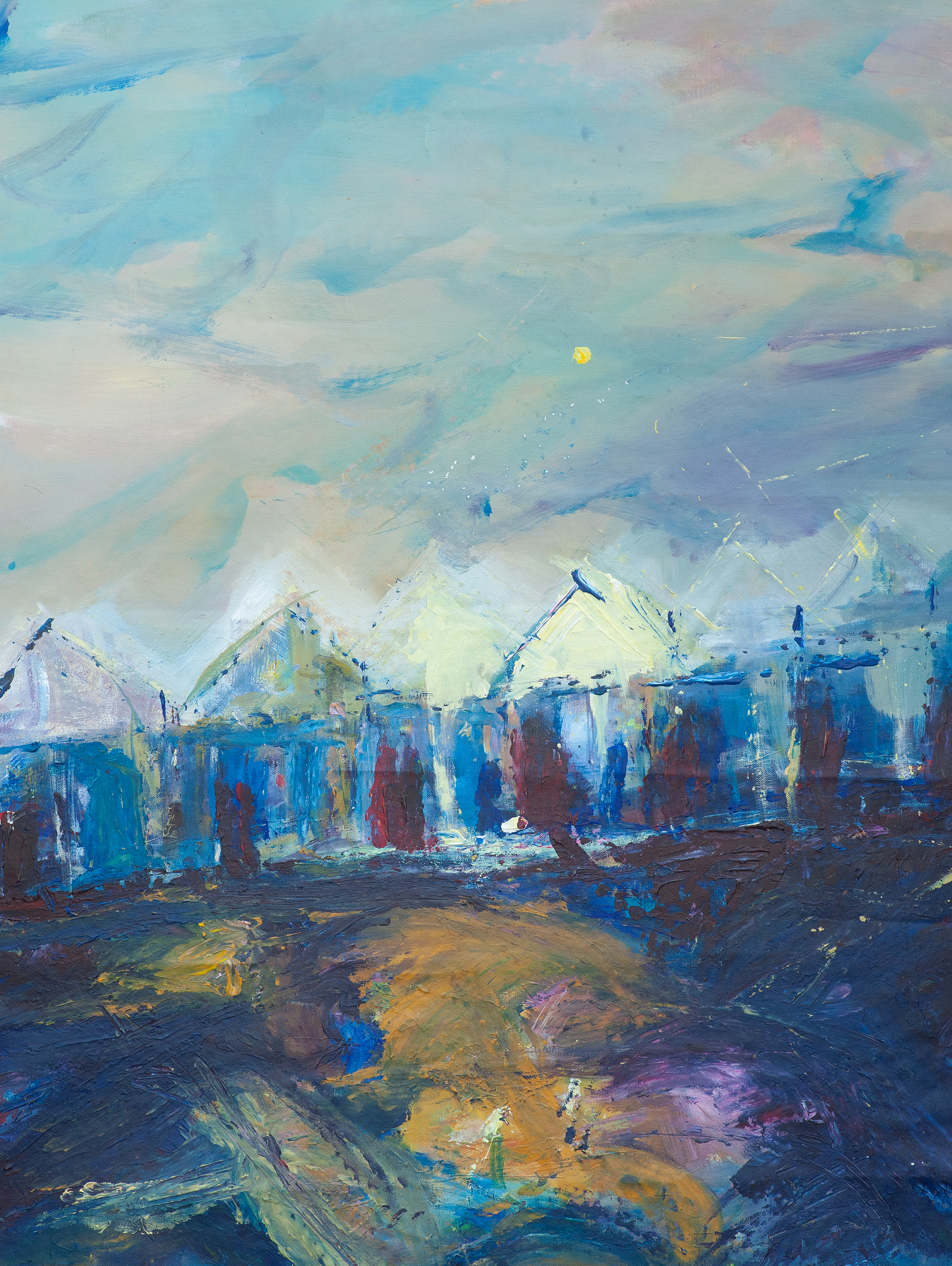
Working with acrylic
It is fast, flexible and practical. I can work in layers without having to wait very long, change something quickly and move back into a painting almost immediately.
I also take acrylic with me. I work with it in Italy, in Iceland, on our fishing boat in Zeeland and at my outdoor workspace. I use it on canvas, but also on paper, including very large sheets.
At the moment I often work with those sheets directly on the floor. There may be bowls of water around me and paint spread across different surfaces. I use brushes, but also my fingers, hands and nails. A finger can become a brush, a scrubber or something close to a palette knife.
The process can become very physical.
In my recent Licht op het land works, for example, I build acrylic in quick layers. Some are transparent, others are not. I use water and transparent medium and respond to what happens as one layer meets another.
These works grew from the landscape around me in the Dutch Bollenstreek: dark soil, bulb fields and greenhouses catching the changing light.

The depth of oil
I still love working with oil paint.
Oil gives me depth very quickly, something I find difficult to describe without simply saying that I find it beautiful. But it asks for a different way of working. The support needs different preparation and the drying time is much longer.
That makes it less practical to move around with, but there are periods when oil is exactly what I need.
The materials do not have to remain separate either. Sometimes a work begins in acrylic and later receives layers of oil. I am not interested in choosing one side. I use what the work needs at that moment.

Charcoal: no distance between my hand and the material
Charcoal has been part of my work since art school. I returned to it strongly when I began working on my Hare series.
What I love about charcoal is its directness.
There is no brush between my hand and the material. I hold it directly, and I can immediately feel what I am doing to the paper, canvas or other surface.
Different types of charcoal behave very differently. They can be hard, soft or brittle. I can make an area almost velvety, rub it out, let it become hazy, press firmly into the surface or barely touch it.
And I can draw by removing material as much as by adding it.
That directness suits the way I work. My own movement and energy remain visible in the marks. Charcoal allows me to put strength and tenderness into the same work.
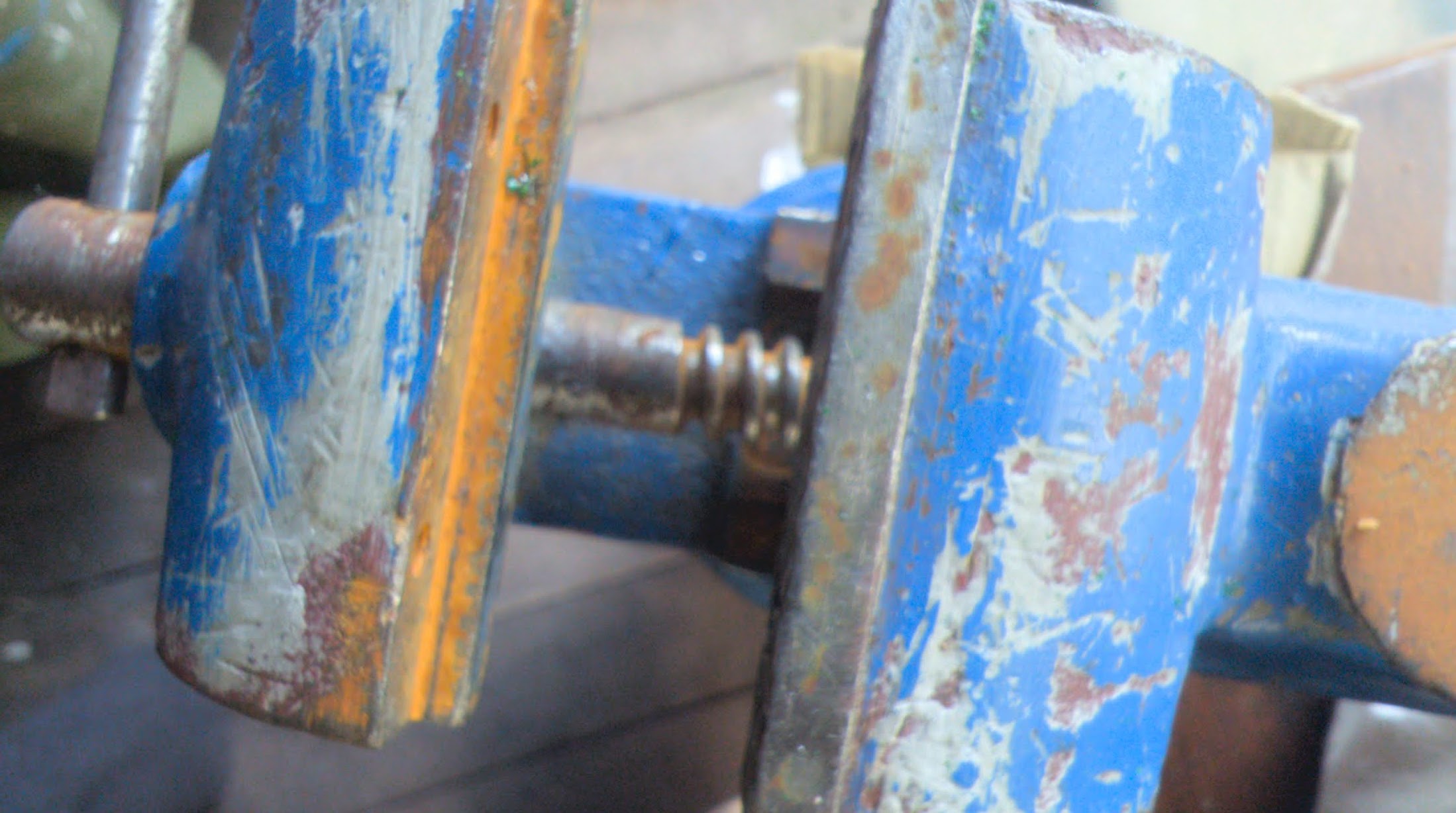
From a flat surface into space
Alongside painting and drawing, I am returning to a way of working that was already important during my years studying 3D Design at art school: material research.
This is a different process.
When I paint, I can enter the image quite quickly. In my spatial work, the research is more phased. I may begin with a theme or an idea I want to investigate, but I first need to find out what the material itself can do and whether it can carry that idea.
At the moment I am working with metal to construct three-dimensional frames. Instead of starting with a ready-made flat support such as paper or canvas, I make the support myself.
I also develop and alter materials in my own way, working with properties such as flexibility, transparency and ink. Some of those processes are deliberately kept within the studio.
The research itself is important. I can start with an intention, but while making, something unexpected may happen. A material can show me another possibility, and I want to leave room for that.
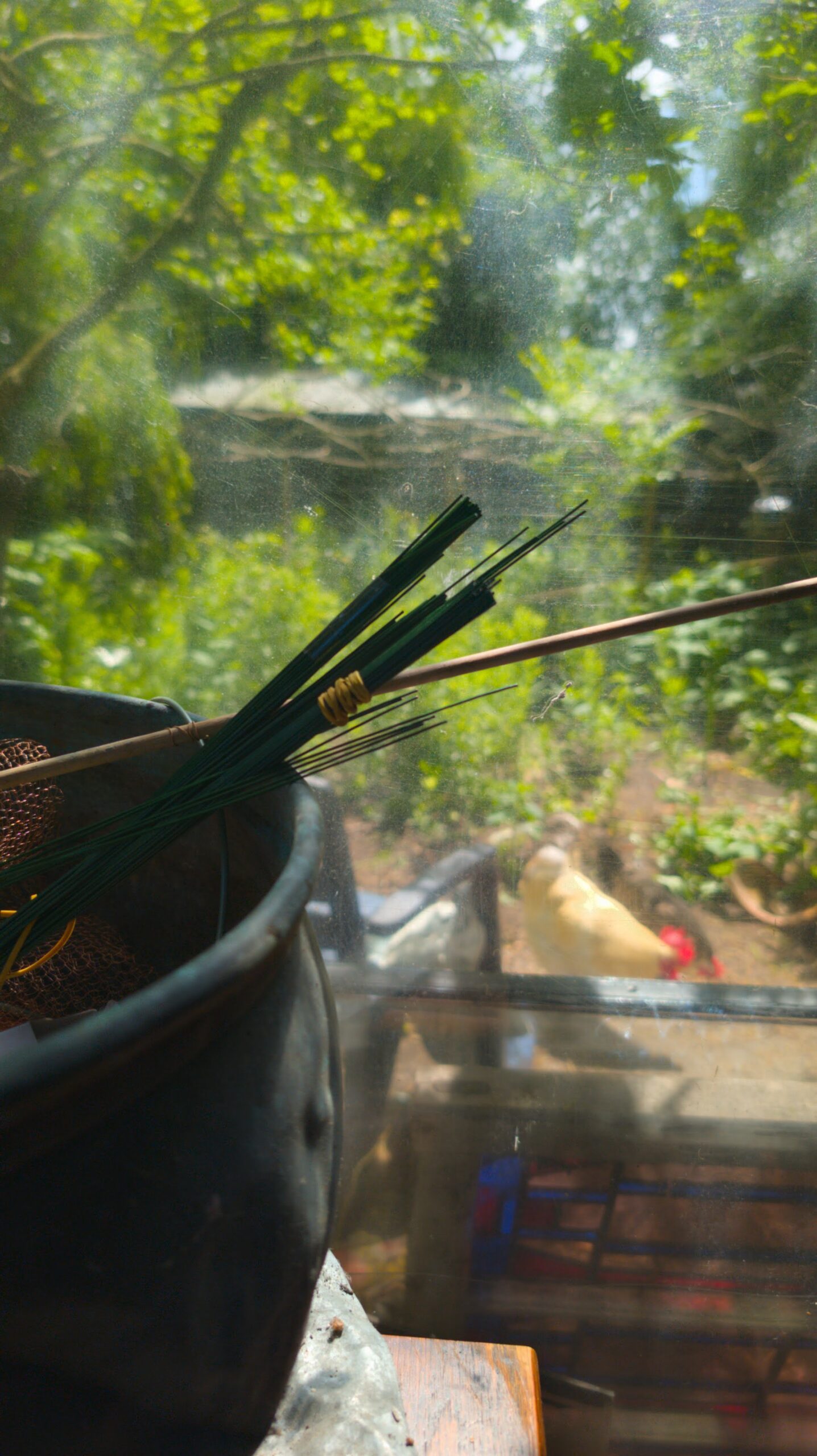

The hidden workspace
Much of this material research takes place in our small outdoor workspace, the boshut.
It is a very different place from my indoor studio. I have a vice there and a place for metalwork. I can saw, bend, construct, test materials and make things that do not yet have to become finished artworks. That freedom matters to me.
In some ways it feels like returning to the way I worked at art school. There is less of that voice in my head telling me how something should look or what it is supposed to become. For a while, it can simply be research.

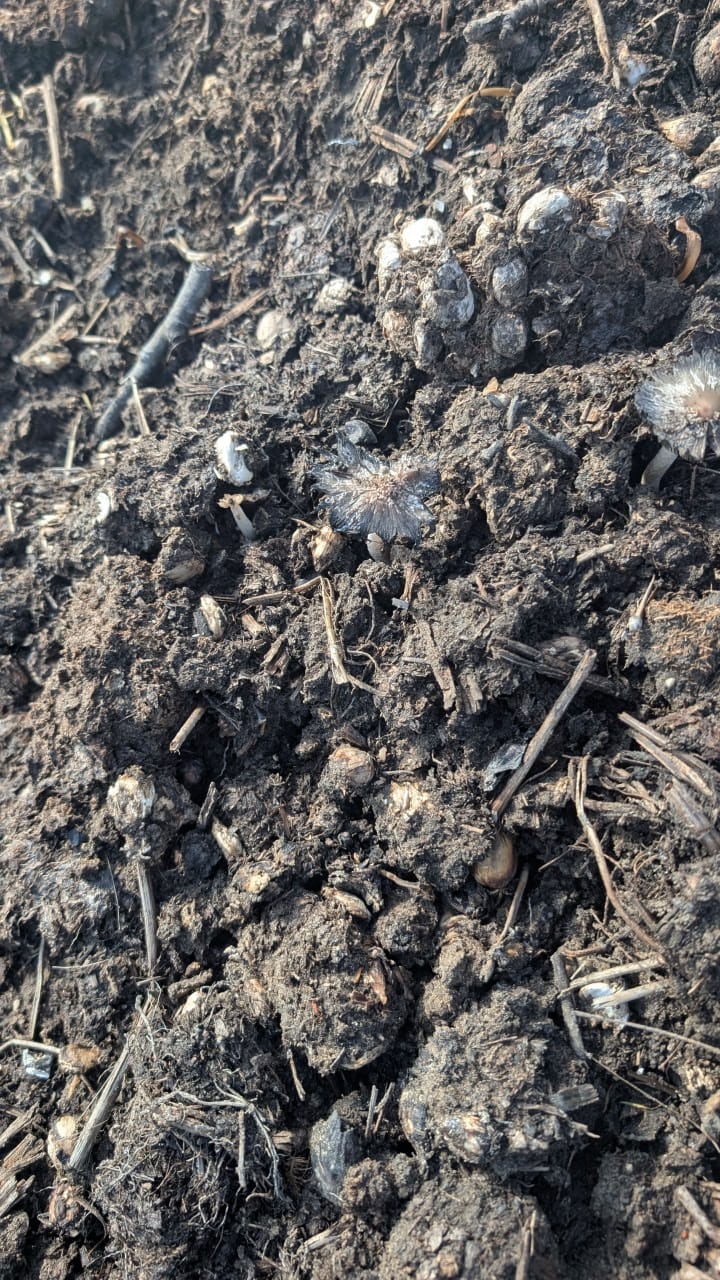
Light, soil and what cannot yet be seen
My current material research is connected to the landscape where I live in the Bollenstreek.
I am looking at the contrast between the dark, rich soil and the almost luminous appearance of the greenhouses standing above it. In certain light, the greenhouses can appear pale blue, grey or milky white. Their glass reflects clouds, blue skies, dark skies and the warmth of a setting sun. I am interested in that contrast, but also in what remains unseen.
Inside the greenhouses, things are growing although we cannot always see them. The same is happening beneath the soil in the bulb fields. Life and cultivation are already present below the visible surface.
That is part of what I am researching now, both in painting and through material and spatial work. There is a larger story developing around it. For now, I am leaving that story where it belongs: in the studio.