
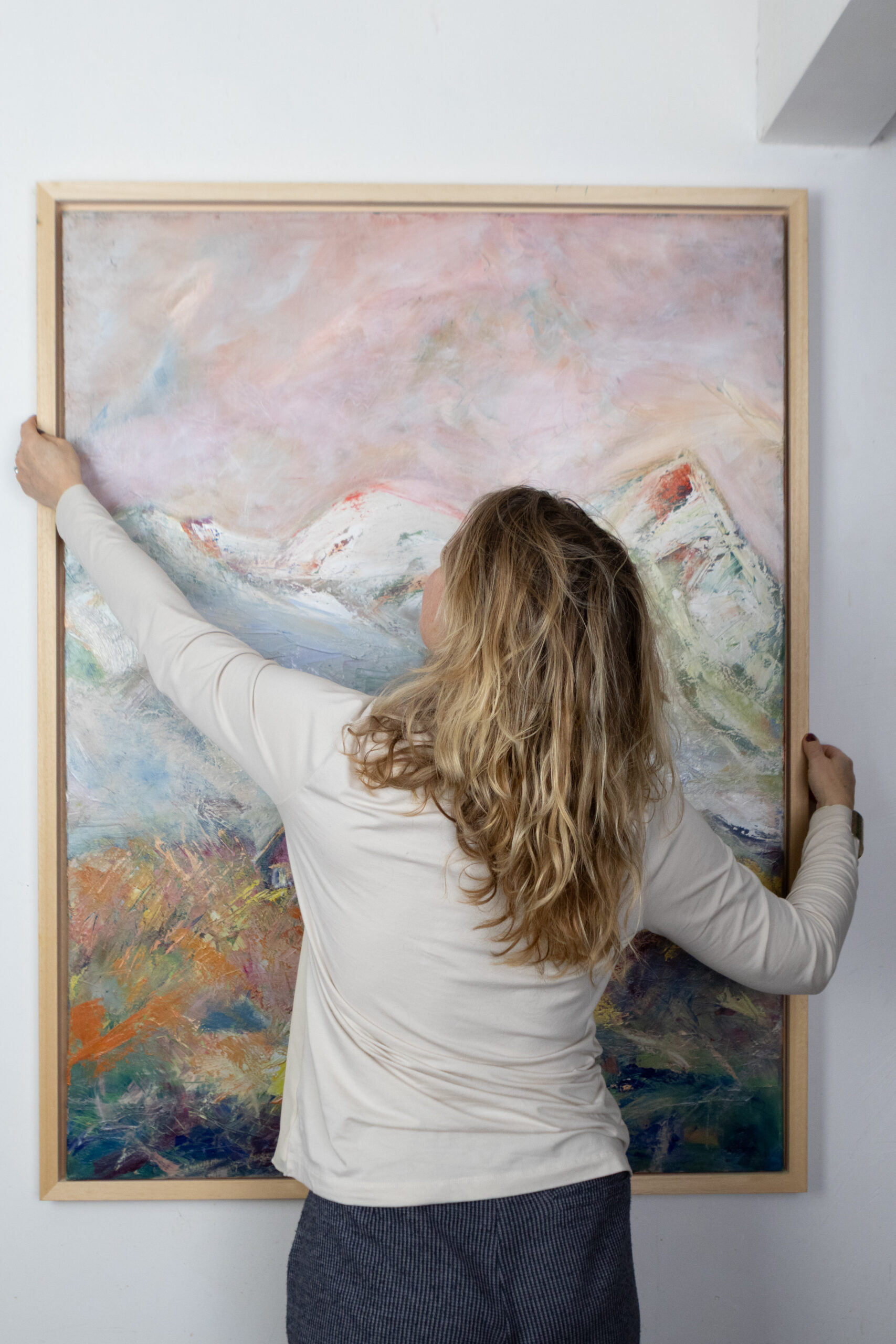

More than decoration
Choosing an original artwork for your home is not always a quick or easy decision. Sometimes you know immediately. A work catches your eye, and before you have made a sensible list of reasons, something in you has already moved towards it. And sometimes it takes longer. You look, walk away, come back and wonder whether the colours are too strong, or perhaps too modest. You imagine the work in your room. And then you doubt everything again, which is very human and also slightly annoying. Because of course, there is also that part of you that would quite like to take something home.
An original artwork brings more into a space than decoration. It brings its own character, surface, rhythm and presence. It can change the atmosphere of a room, sometimes more than you expect. But how do you choose a work that feels right in your home? I don’t believe there is one perfect formula for that. I do know that living with art has taught me quite a lot about the relationship between a painting and the space around it.
A WALL OF MY OWN
Our living room is a large, studio-like space, and Rob and I each have our own territory when it comes to displaying art. Rob has a wall and a long shelf for sculptures. I have another wall and a few smaller shelves. It’s a rather nice arrangement, actually. We each have room to make our own compositions, although everything still belongs to the same living space.
At the moment, my wall is filled with paintings from different series. They vary in colour, size and character, and some seem to contradict each other. Yet when I look at the whole arrangement, I feel a certain balance. Not because everything matches perfectly, but because the differences create a tension that I enjoy. I like the way one painting can change how you experience the work beside it.

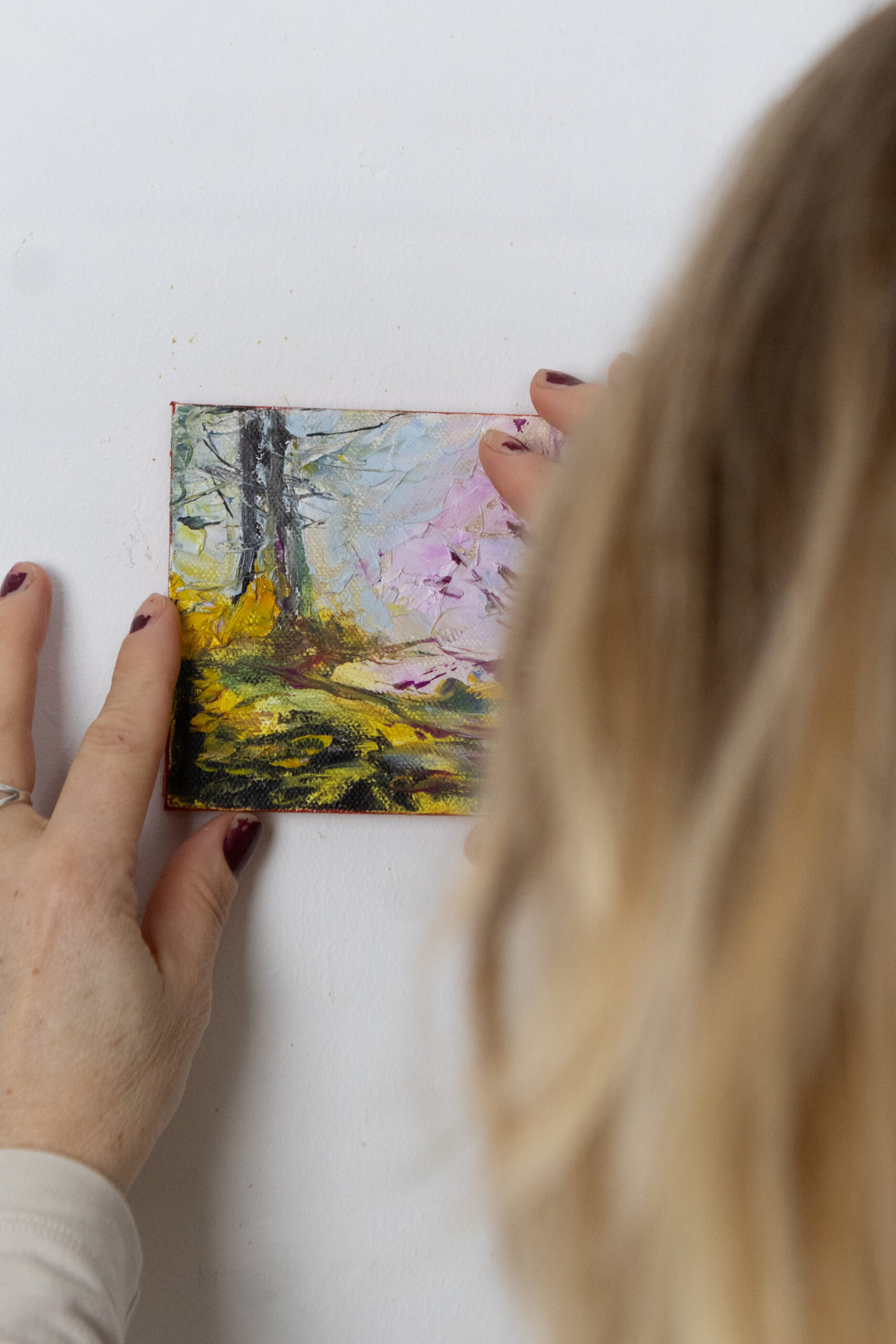
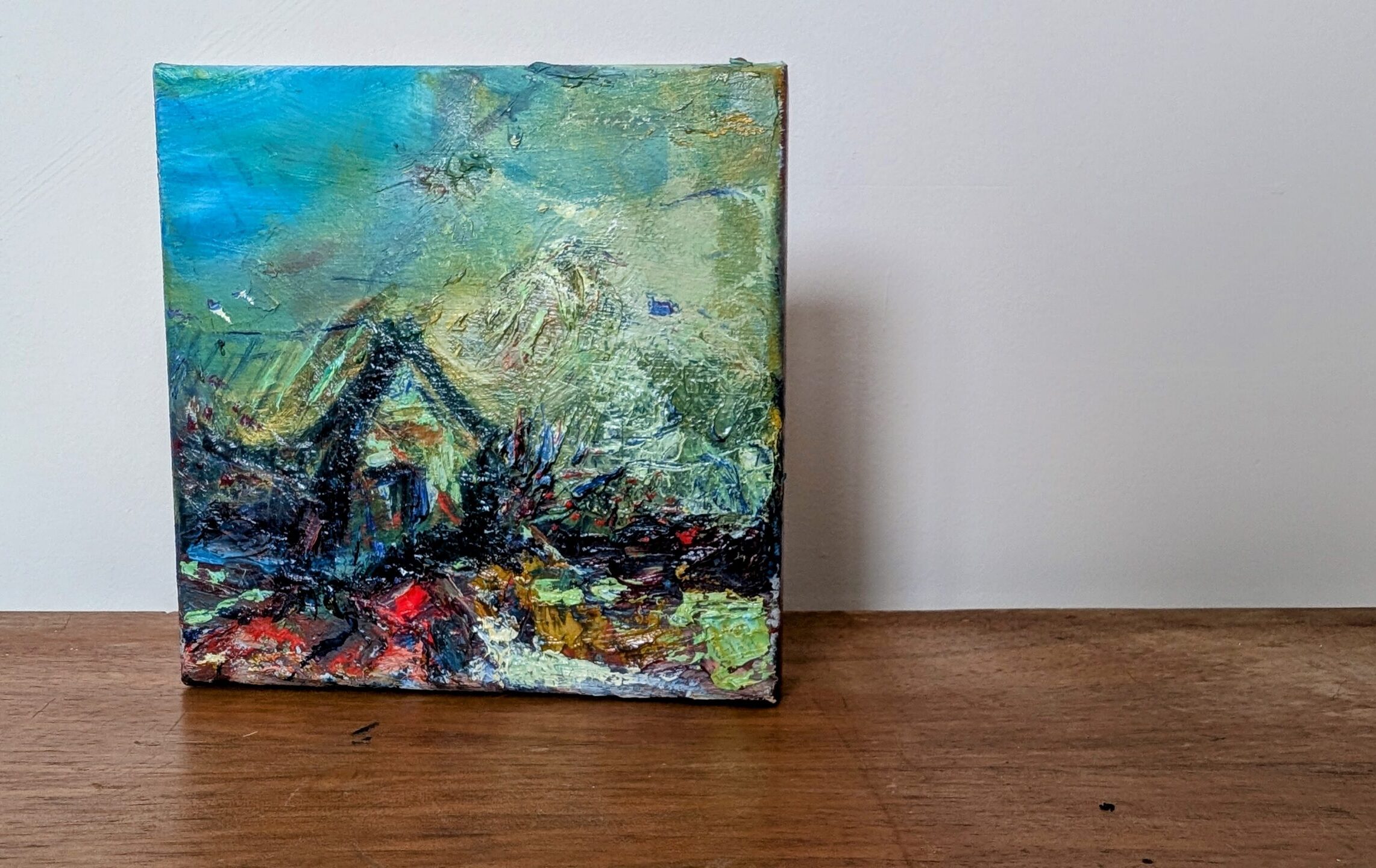
Three very small, expressive paintings hang next to each other, with just a little space between them. Together, they almost become one work. I’ve left plenty of room around them, and nearby hangs a much larger painting with depth and a somewhat mysterious atmosphere. There are other works on the wall too, but these two arrangements seem to attract the most attention.
When we have visitors, I love watching where they go first. Some walk straight towards the three little paintings. You really have to get your nose close to them to discover what you’re looking at, and that seems to draw people in. Others are immediately attracted to the larger painting. It has a certain stillness, but there is a lot happening in the landscape, and the longer you look, the more you discover. I find that fascinating. The smallest works invite you to come closer, while the larger painting seems to create a space of its own.
“Proportions matter, of course, but there is more to consider than measurements.”
SIZE IS NOT THE SAME AS PRESENCE
Living with those three small paintings has reminded me that the physical size of an artwork doesn’t necessarily determine its presence in a room. A small work can attract an extraordinary amount of attention, particularly when it contains something you want to examine more closely. Equally, a large painting doesn’t have to dominate a space. Depending on its composition, colour and atmosphere, it can bring a surprising sense of calm.

That is why I wouldn’t automatically choose a small painting for a small room or a large painting for a large wall. Proportions matter, of course, but there is more to consider than measurements. Sometimes a small work needs generous space around it. Sometimes several small paintings become much more interesting when they are brought together. And sometimes a larger work gives a relatively compact room a sense of depth that wasn’t there before.
When I arrange paintings at home, I look at the relationships between them. What happens when two different colours meet? Does one composition make the other feel more energetic? Is there enough space for the eye to rest? I don’t always know the answer beforehand. Quite often, I only discover it by moving things around and looking again.
YOU DON’T HAVE TO MATCH EVERYTHING
A good first question when choosing art for your home is not necessarily: does this match my sofa? It might match your sofa. Fine. I have nothing against sofas. But if that is the only consideration, you might miss a work that could bring something much more interesting into your home.
I understand the temptation to choose art that fits perfectly with an interior. We spend time selecting colours, materials and furniture, so naturally we want the room to feel coherent. But I think a painting can be particularly interesting when it introduces something that wasn’t already there. It might bring an unexpected colour, a certain roughness or a completely different atmosphere.
On my own wall, the works come from different series and weren’t made with the intention of hanging together. Their subjects, colours and visual rhythms vary considerably. That is precisely what makes the combination interesting to me. If I had insisted on keeping everything within one colour palette or one particular atmosphere, I would have lost much of the tension that now gives the wall its character.
That doesn’t mean every combination works. Sometimes I hang something and realise almost immediately that it needs to move. Other times, an unexpected pairing turns out to be exactly right. I prefer to discover those relationships rather than decide in advance that certain paintings cannot belong together. Your home doesn’t have to look like a gallery, and an artwork doesn’t have to behave like an accessory. It can have a character of its own. In fact, I rather hope it does.
LOOK AT THE SURFACE, NOT JUST THE IMAGE
Online, a work can look clear and direct. In real life, scale changes everything. A small painting may feel more powerful than you expected, while a large work can be surprisingly quiet. But size is only part of the experience. There is also the physical presence of the work itself.
Look at the skin of the painting. The material, the edges, the places that are smooth, rough, open or unresolved. A layered canvas may have a different physical presence from a work on paper. A study can reveal the movement of the hand in a particularly direct way. These are things that can be difficult to judge from a screen, however good the photographs are.
I notice this in my own studio. A painting can look quite different when I move it from one wall to another, or when the daylight changes during the afternoon. A darker passage may suddenly become more visible, or a colour that seemed quiet begins to demand attention. Those changes are part of the pleasure of living with an original work. You don’t necessarily see everything at once.
If you’re considering a painting online, I would encourage you to look beyond the main photograph. Ask for detail images, a short video or a photograph that shows the work in relation to its surroundings. And if you have the opportunity to see it in person, take it. You may discover something that confirms your first impression, or something you hadn’t noticed at all.

LET THE ROOM CHANGE
The arrangement on my wall has been there for about seven months now. There are more paintings around the three little works and the larger landscape, and lately I’ve been thinking about changing the composition again. Partly because the season is changing, but also because I feel that certain works deserve a different space now.
I don’t consider the arrangement of art in our home to be finished. Moving one painting can alter the entire composition. A work that has been quietly hanging in the background may suddenly attract your attention again. Another may feel better in a more secluded spot. Sometimes changing the position of a painting is enough to make you look at everything else differently.

The three little paintings are another matter, though. I’ve become quite attached to them, and I’m not sure I’m ready to part with them just yet. I can imagine rearranging the wall around them, but letting them leave the house altogether is a different question. Being the artist who made them doesn’t necessarily make that decision any easier.
Perhaps that’s another thing about living with art. You develop relationships with particular works. Some remain in the same place for years, while others move around with you. Their surroundings change, your attention changes, and sometimes the way you see them changes too.
A WORK BECOMES PART OF DAILY LIFE
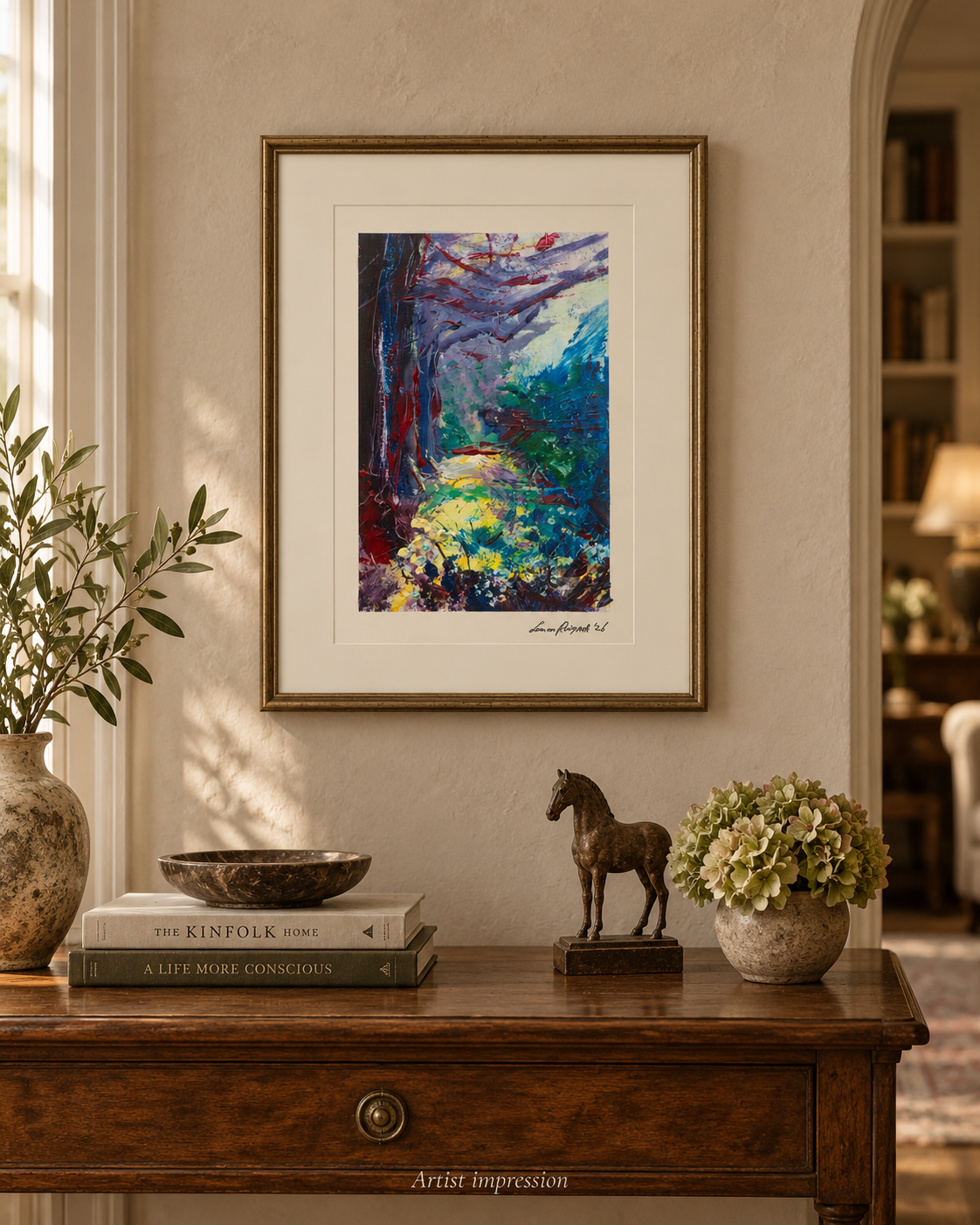
When you bring an artwork into your home, it doesn’t remain separate from life. It enters the space where you drink coffee, read, argue, rest, walk past, forget things and remember things. It becomes part of your everyday surroundings, rather than something you only look at when you deliberately stop in front of it.
That is why I believe choosing art deserves attention. Not fear, and certainly not endless overthinking, but attention to what genuinely interests you. Perhaps it is a particular colour, a figure, an expressive gesture or a landscape in which you keep discovering something new. Perhaps the work is quiet, or perhaps it brings exactly the kind of tension your room was missing.
Of course, you still need to consider the practical questions. Measure the wall, look at the light and think about where the work might hang. But don’t feel that you have to know its perfect, permanent position before bringing it home. A room can change, and so can your relationship with a painting.
I certainly don’t want my own walls to stay exactly the same forever. Although, as I’ve discovered, there are a few little paintings I may have trouble letting go of.
SEE THE WORK IN PERSON
If you’re curious about how a particular painting might feel in your own home, you’re welcome to explore my available works, artist studies and selected studio archive pieces. During a studio visit, you can experience the scale, surface and colour of the works beyond the screen, ask questions and take your time looking. There is no obligation to decide immediately.
For more practical guidance on measurements, placement, colour, framing and assessing an artwork online, you can also read my complete Buying Art Guide.